
Housing need is more than a number — and delivery is more than building houses
Opinion piece by Tertuis Simmers, Western Cape Minister of Infrastructure
Housing is one of the most personal and pressing issues facing families across the Western Cape.
For someone who has waited years for a home, a serviced site or another form of housing assistance, statistics provide little comfort. Government therefore has a responsibility not only to deliver, but also to explain honestly how the housing system works, what the numbers actually mean, where the challenges remain, and where progress is being made.
Two issues in particular deserve a factual conversation: the Housing Demand Database and the transfer of title deeds.
A housing database is not simply a waiting list
The Western Cape Housing Demand Database records households that have registered their need for housing assistance.
That distinction matters.
Being registered does not automatically mean that a household currently qualifies for a particular housing subsidy or project. Registration records housing demand. Qualification is determined when a household is considered for a specific housing opportunity and its circumstances are verified against the applicable criteria.
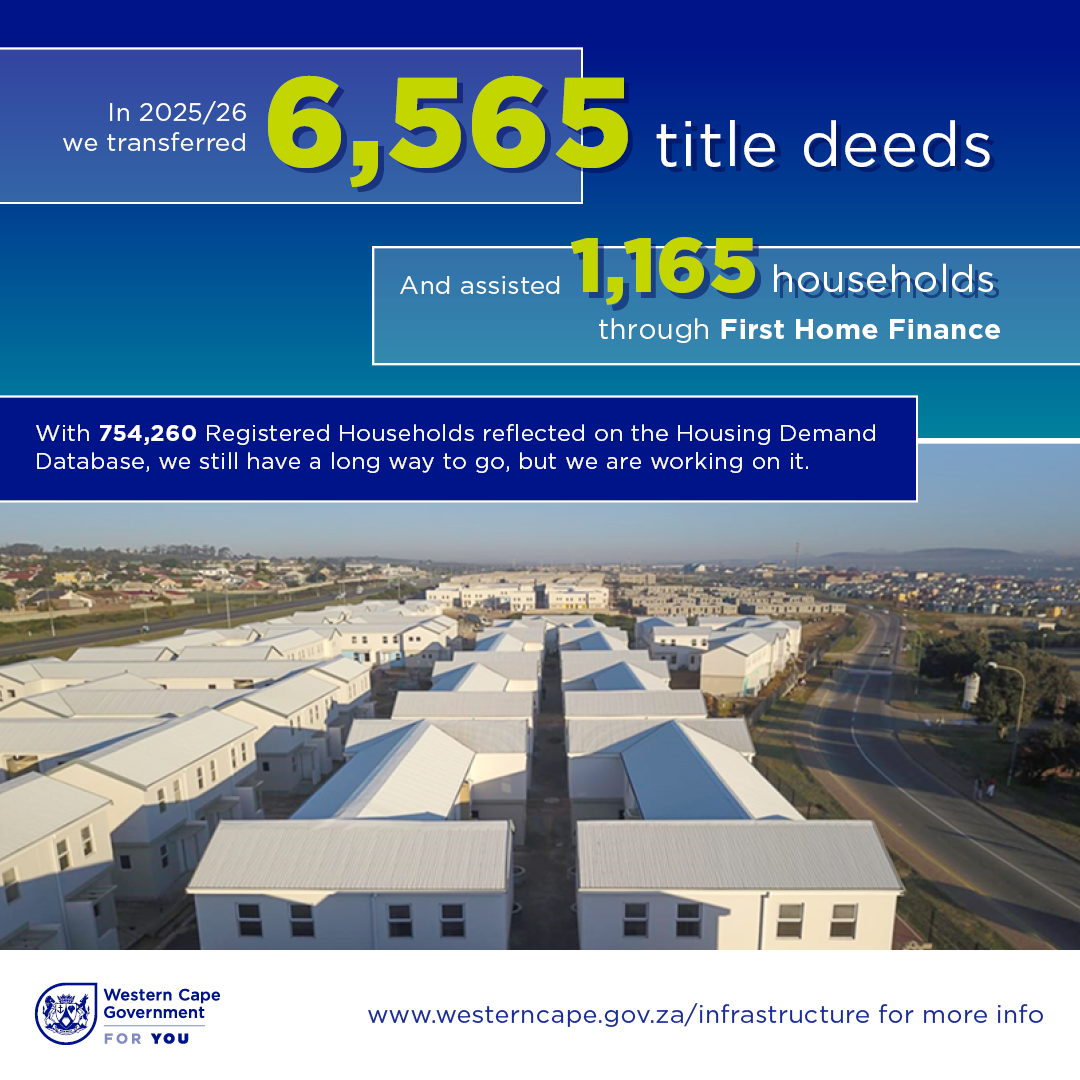
The database currently reflects more than 750,000 registered households across the Western Cape. That is a powerful indicator of the scale of housing need in our province.
But it should not be interpreted as though more than 750,000 families are standing in one queue, waiting for exactly the same government house.
They are not.
Housing circumstances change over time.
People move. Household composition changes. Income changes. Some applicants acquire property. Some may already have received government housing assistance elsewhere. Sadly, some applicants pass away. Contact details change. Other households may move into an income category that makes them eligible for a different form of housing assistance.
This is precisely why residents need to keep their information updated and why beneficiary verification is so important.
Verification is not about removing deserving people from the system. It is about making sure that scarce housing opportunities reach the correct qualifying beneficiaries.
There is no single housing solution
Another misconception is that every household recorded on the database requires the same housing product.
Housing need is far more complex.
One household may qualify for a fully subsidised housing opportunity. Another may benefit from a serviced site. A family living in an informal settlement may benefit from upgrading, improved basic services and greater security of tenure.
A working household earning between R3,501 and R22,000 per month may not qualify for a fully subsidised home but could qualify for First Home Finance assistance to help enter the property market.
Others require social or affordable rental housing.
That is why our housing programme includes subsidised homes, serviced sites, informal settlement upgrading, First Home Finance, social housing, affordable housing and title-deed transfers.
During the 2025/26 financial year alone, the Western Cape delivered 5,213 completed housing units and 1,358 serviced sites. We assisted 1,165 households through First Home Finance, while informal-settlement upgrading was advanced through 44 projects.
These are different interventions, but they share the same objective: helping more Western Cape residents gain access to safer, more secure and more dignified housing.
Municipalities also have a critical role.
Housing projects cannot simply be placed wherever the greatest number of names happens to appear on a database.
Human-settlement planning must consider available and suitable land, bulk infrastructure, water and sanitation capacity, transport connections, schools, economic opportunities, planning approvals, funding and the needs identified through municipal planning processes.
That is why housing delivery is ultimately a partnership between residents, municipalities, the Province, national government and, increasingly, the private sector.
Title deeds: acknowledging the backlog while accelerating delivery
There is another part of the housing story where government must be equally candid.
The Western Cape has a title-deed backlog.
The Housing Subsidy System currently reflects approximately 40,217 beneficiaries awaiting title deeds, although this figure still requires municipal verification and the underlying data is not complete.
We should not hide from that challenge.
But neither should we ignore the progress being made to address it.
A government-subsidised house provides shelter. A title deed provides something more: legally registered ownership.
It gives a family security of tenure. It provides an asset that can pass from one generation to another. And it gives people documentary proof that the property they have occupied, sometimes for many years, legally belongs to them.
That is why accelerating title-deed transfers has become such an important part of our housing programme.
In 2024/25, the Western Cape delivered 6,515 title deeds against a target of 2,900. In 2025/26, that increased further to 6,565 title deeds.
In the first quarter of the current 2026/27 financial year, a further 1,187 project-linked transfers had already been verified.
Behind those provincial numbers are real families and real communities.
At Vredendal Phase 6, 264 homes were matched with 264 title deeds. In Bergrivier, 392 homes were handed over alongside 389 title deeds. At Metro Grounds in George, our approach has increasingly been to bring the transfer of ownership much closer to the moment families receive their homes.
That is the direction in which the entire system must move.
We should not be building today's housing projects while simultaneously creating tomorrow's title-deed backlog.
Housing delivery must be measured honestly
There is no credible argument that the housing challenge in the Western Cape has been solved.
It has not.
Demand continues to exceed the resources available to government. Suitable land is limited and often expensive. Bulk infrastructure is constrained in many municipalities. Construction costs continue to rise. National housing funding has also faced significant pressure and reductions in recent years.
These constraints are real, and government must be honest about them.
But honesty must work both ways.
It would be equally misleading to suggest that housing delivery is not taking place.
Thousands of homes are being completed. Serviced sites are being provided. Informal settlements are being upgraded. Working families are being assisted into home ownership. Affordable and social housing projects are being advanced. And thousands of families are receiving the title deeds that turn occupation into legally registered ownership.
The challenge before us is therefore not to defend a number.
It is to improve the system.
That means maintaining a more accurate Housing Demand Database. It means continuously verifying beneficiary information. It means matching households to the housing products appropriate to their circumstances. It means working with municipalities to identify where infrastructure and land can support new developments. And it means accelerating title-deed transfers while preventing new backlogs from developing.
Housing need is real.
The backlog is real.
But so is the progress.
Our responsibility is to acknowledge all three — and then keep doing the work required to give more Western Cape families a secure place to call home.